


FKMT Akagi. AKWS.
for 0831 AKWS event. I translated my novel [Wildlife] into English for my foreign friends. The subject was added in the form of an English-American novel, and the narrative was changed. This is my first time translating it myself, so I hope you enjoy reading it.
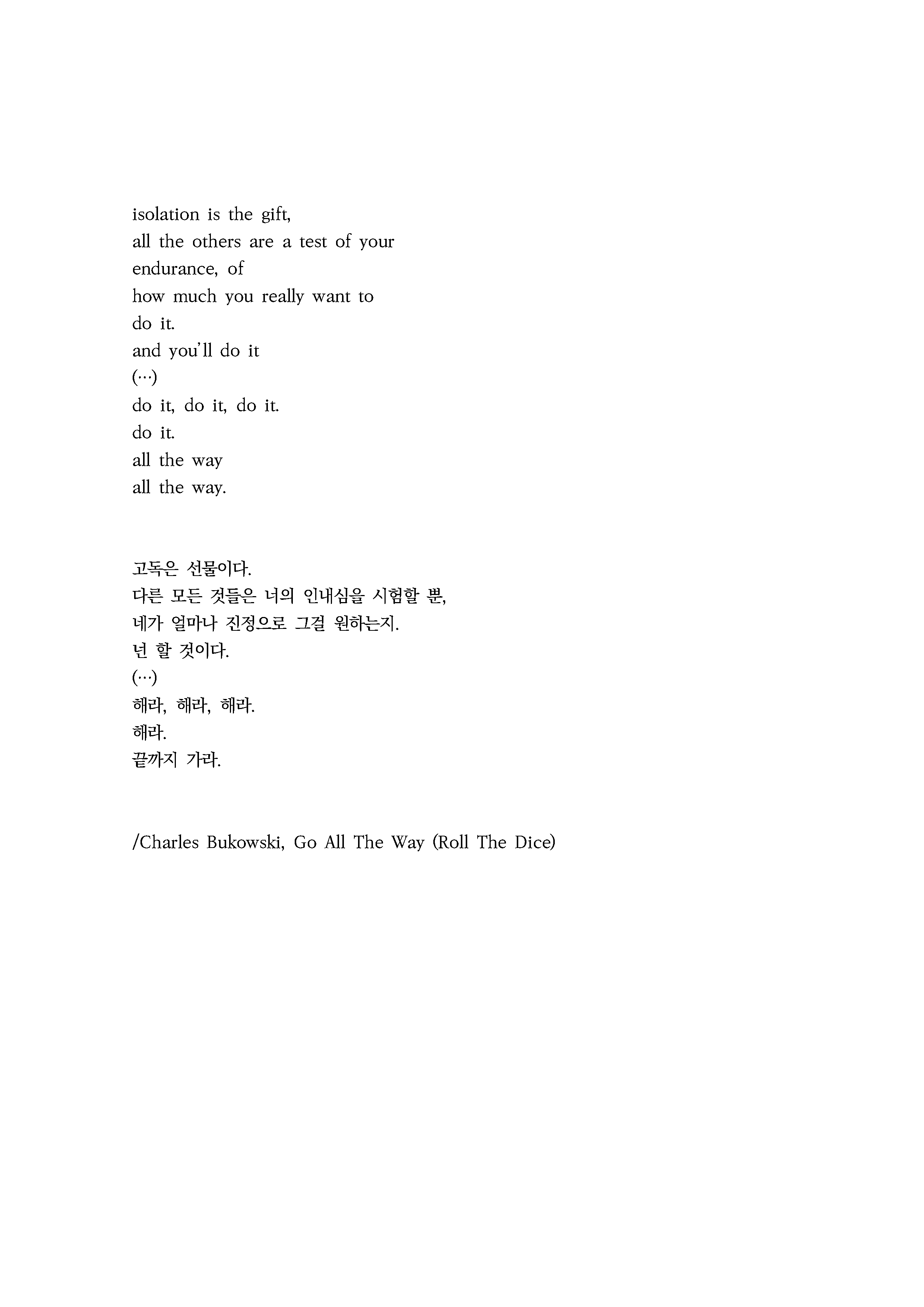
isolation is the gift,
all the others are a test of your
endurance, of
how much you really want to
do it.
and you’ll do it
(…)
do it, do it, do it.
do it.
all the way
all the way.
고독은 선물이다.
다른 모든 것들은 너의 인내심을 시험할 뿐,
네가 얼마나 진정으로 그걸 원하는지.
넌 할 것이다.
(…)
해라, 해라, 해라.
해라.
끝까지 가라.
/Charles Bukowski, Go All The Way (Roll The Dice)
야생동물
WILDLIFE
The news of Iwao Washizu's death came as no surprise. He was already an elderly man when I first met him. In this day and age, he lived a long life. Living a long life is not necessarily a blessing, but he enjoyed his life to the fullest and was surrounded by loyal vassals. In that sense, it was a blessing. I also felt that he had lived quite a long time. If the deceased knew, he might yell that it was outrageous. Thinking of his rude, disrespectful voice, spewing out all kinds of harsh words, I almost burst out laughing. But that won't happen. When you die, it's over. He can't scold me anymore. It's all over. (The fact that nothingness awaited me after all my nonsense was what kept me going in life.) Akagi was going to give him time until he finished his cigarette, but he threw the soldier who had died heroically on the ground and took out a new soldier and put it in his mouth. The white robe in front of him did not stop him. He just looked at his face and shook his head. Huh. Not all cigarettes are sighs. It's not like you're in mourning or anything. I just want to smoke one more. Akagi had grown up enough not to say such things out loud. He had grown up. He had grown old. That's right. It was appropriate to say he had grown old. After the first digit became 2, everyone seemed to describe it as growing old. The same was true for the white-robed man in front of Akagi. Was it Suzuki? It took time to recognize him because of his wrinkles, but I think that was his name. Akagi was now on his fourth cigarette, and no one spoke. Suzuki remained silent, and Akagi let him misunderstand. Akagi thought that if someone spoke, it wouldn't be his turn. It was an overly peaceful morning. As the clouds drifted by, the patterns created by the light and shadow fell on the two men's faces. When the sunlight came back in, they had no choice but to squint their eyes. It was painful. Akagi was just… tired. I don't care about lords, vassals, or loyalty. I suppose I should say it's amazing that he found me somehow. But I wonder why he's telling me about the past now. I wanted to leave the unwelcome guest alone and go back to my inn room to take a nap. It was because yesterday's mahjong game had been so exhausting. The days when I could stay up all night with clear eyes and excitement enveloping my whole body seemed like a past life. It's exhausting. Time is long and exhausting. Finally, Suzuki spoke again.
“I wanted to let you know that things won't be the same as before.”
“Not the same as before?”
Even though Akagi wanted to end this conversation as quickly as possible, He asked Suzuki to repeat himself. It was because of his personality that He couldn't stand not knowing the answer when He had a question. Akagi had been held back by this habit for a long time. Then Akagi immediately realized that he had done something he would regret.
“Mr. Washizu can no longer help you.”
The fourth cigarette was extraordinary compared to the previous ones. It was so short that it ended up burning his fingertips. Akagi realized only then that he had been holding the cigarette blankly. His fingers were sore, but he felt as if he had been doused with cold water. Suzuki continued.
““Did you really not notice anything?”
*
After the big game on August 31, Iwao Washizu found it difficult to survive on his own. In any case, he now needed money more than anyone else. Previously, he had enjoyed accumulating money, but now he had to accumulate it to search for Akagi. He also had to make a living for himself. (He couldn't just keep all these underlings on his payroll, could he?) However, he had to maintain his position behind the front lines. Given the situation, where he was about to flee, it was impossible to engage in any business that would expose his name. While ordinary people might have been discouraged by the situation, Washizu was experienced. There was one business he could do without exposing his name. After all, Washizu had all sorts of dirty secrets in his head, spanning the judicial and political worlds. It was a remarkable thing. After making a few phone calls, money that a worker would never be able to touch in a lifetime began to pour in within a few days. Politicians facing elections feared being disgraced, and prosecutors feared being brought to trial. Washizu found all this farcical. What disgraced them was not what came out of Washizu’s mouth, but their very existence. If one truly wanted to live with integrity, one had to choose between feigning indifference or abandoning the desire for power. The combination of mediocre talent and the half-hearted desire to have both led them to trap themselves. All of this was far removed from Washizu's world. There are certain roles in this world that allow you to have it all. It's more than just being part of the privileged class; it's like being at the top of the pyramid. Washizu was once there. From that position, he could laugh at everything he wanted. (He could have become lonely.) In any case, he is now an old extortionist living off other people's money. He couldn't avoid the gossip that came with his outstretched hand. The renowned Iwao Washizu has gone mad. He seems to have been mad for a long time, but now he is searching for someone with fire in his eyes. We don't know if it's his illegitimate child or a young woman... Washizu thought the gold rush was something that happened across the sea, but it seems that it happens anywhere when interests and greed are intertwined. If they just wait patiently, the old extortionist will surely die and take his many secrets with him. Impatient and hot-tempered individuals have taken it upon themselves to exploit Washizu's weakness. If they can find that person first, the tables will turn. They won't have to be fleeced by the old man. It didn't take long for this determination to reach Washizu's ears.
“How thoughtful. To keep old man from getting bored, Akagi have created all these entertaining things for me.”
Instead of answering, Okamoto thought that Washizu was too absorbed in this game. It was embarrassing to think of his lord's derogatory nickname, but as a monster of the Showa era, this power struggle itself felt unfamiliar and refreshing. Washizu-sama in his prime had no need for such things. If someone tried to stab him, he would simply crush them with his weight and be done with it. It was a predictable victory, a repetition, a celebration. Unlike the predetermined process of assembling toys on rails, this old man now had to raise his guard and defend himself with all his heart. He was being beaten by a mediocre force because he was preoccupied with a rogue traveling around the country. When Okamoto saw Washizu being humiliated by substandard people, it felt like a cold surgical knife was twisting his intestines. He felt like he was following his father, who was once respected by everyone but is now unemployed, wandering the streets. The young Washizu had a sparkling energy about him. He was mean but noble, persistent but knew when to back down. He took everything that belonged to others, but he acted as if he was just taking back what was rightfully his. He didn't seem to believe in karma or fate. I was fascinated by his arrogance. I wasn't the only one who was anxious about the current changes. Most of the white-robed men didn't like the variables.
“Shigeru Akagi corrupted our boss. Whether it's good or bad, our boss is not at an age where he needs to change.”
This was something you would often hear when three or more people got together, even without alcohol or cigarettes.
“That's right. Rapid change should end in one's reckless youth. This kind of thing is only harmful to the elderly. There's no way it can be good.”
“You mean it won't end well?” Okamoto had quit smoking several years ago, but he was still standing with the guys who were smoking.
"The process isn't good. Everything’s rotten.” One of them said firmly as he tapped his cigarette ash.
“Look, look. Bang! something definitely hit our boss. It’s not just traffic accidents that have aftereffects. When something like that sweeps through a person’s life, they can’t live normally anymore. People who have experienced something like that can’t and shouldn’t continue living their lives as before.”
“He haven’t completely changed,” Suzuki added. “I’ve endured our boss for a long time. The mood swings and frequent outbursts are still the same.”
“The boss and we are similar,” he said, turning his back.
“It’s outdated now. Times have changed, so either adapt or be left behind.”
*
The problem began in the third year of the search. Until then, Washizu had been able to hide behind various rumors, such as that the person he was looking for was an illegitimate child or a young woman. However, after the fishing village's rampage, the truth that the target was Akagi Shigeru began to spread little by little. The source, of course, was the Yashiro faction of the Migawa clan. Akagi had been humiliated by Akagi, and Washizu's unilateral visit had further inflamed the gangsters, who were already on edge. No matter how much they tried to keep their mouths shut, the lower ranks couldn't maintain their unity. Akagi Shigeru, who swept through the workplace, was a young man who appeared and disappeared suddenly, but at the same time, there were testimonies that he was not very cautious. The Washizu of old would not have made such a mistake. When trying to persuade someone, you had to either charm them or intimidate them. The Yashiro faction was in a desperate financial situation after being targeted by Akagi, so if they had had enough cash, they could have easily handled the situation. But that wasn't the case. The current Washizu lacked both ammunition and resources. There was no room to waste on a slim chance. The first to catch on was a politician from the ruling party. After visiting the VIP room several times, he was able to obtain a rough sketch of Akagi Shigeru. The work proceeded step by step. First, this politician identified people in similar circumstances (those who had benefited from Washizu Iwao but were also victims of his threats) and managed to gather a few of them. Finding people ultimately comes down to a matter of bullets. Materialism—the ability to do almost anything with money—was their weapon. They began searching for young people in a manner similar to Washizu's, narrowing down suspects within a few weeks. The location was an infamously notorious mahjong gambling den. However, their purpose differed from Washizu's. A cautious politician who didn't want to get caught didn't need to go to such a seedy place. The leader among them recalled his experience and made a call. The call contained false information about Akagi Shigeru's whereabouts and safety. Washizu arrived at the VIP room in just one hour. Men in white suits opened the door and escorted him to the sofa. As soon as Washizu sat down, he requested whiskey, and they provided it.
“Your throat must be very dry.” In the past, he would never have dared to say such a thing to an elderly person in front of him. One of the white robed servants almost shouted out, but he managed to restrain himself after glancing at his master. Washizu rolled up his sleeves and took the cup. He seemed to be moistening his throat, but then he spat what he had in his mouth back into the cup. The laughter that had been floating in the air died down. The white-robed man on the left busily wiped Washizu's mouth with a handkerchief. It took him a while to put the cup down on the table.
“I was curious to see what kind of great wine the rats were drinking as they sat together in their burrow.” Washizu replied, rubbing his stiff knees.
From that moment on, they sensed that something was different from what they had expected. Their opponent, who had come to negotiate while clutching his weakness, was more energetic than they had anticipated. It was not his physical strength, but his mental strength that seemed impossible to easily crush. In a way, it was only natural. They were not young, but compared to Washizu Iwao, they were still novices. Above all, politicians were afraid of being beaten. They overestimated their own strength and didn't want to suffer even the slightest loss. On the other hand, what about Iwao Washizu? He was a businessman who had been through many trials and tribulations. A businessman should not be like that. If you really don't want to get hit, you have to make sure that your opponent can't even imagine hitting you.
“Let me say this first,” the old man began.
“As you can see, Akagi was neither an illegitimate child nor a young woman. That man is neither my blood relative nor my lover.” The people in the room exchanged glances as he spoke in a tone that seemed to be comforting a child.
“I’m just looking for him out of curiosity, so whether you kill him or not is none of my business. To be honest, I came here thinking you would bring me his head. If you wanted to make a deal with me, you should have prepared that. This is a matter concerning your political future.” Half of what he said was true. Washizu Iwao had no regrets. The man he wanted to meet was the man from August 31st. If his life depended on such people, he was already a worthless young man. It was a plan that had started with cowards who were afraid. What could people who valued their own bodies so much, without understanding the clear cause and effect or history, possibly do? What harm could they do to Akagi?
The bluff worked. The two politicians, who had been standing there at a loss, slowly sat down at a distance from each other. If there had been only one dog, it might have taken a long time to turn the tables, if only because of the pride that had been barking until just a moment ago, but the problem was that there were several dogs. They were each other's competitors. “This is really something.” Then he forced a sad smile. It was a smile meant to cut off the tail and climb the ladder. The politician who had been at the forefront now realized that these people were not on the same side, but could turn against him at any moment. Washizu Iwao was a monster of the Showa era and a symbol of fear. This group had no center of gravity or guts to reverse their learned fear. Washizu smiled gently at the politician, who was now standing alone.
“Sit down. You have to finish what you were saying.” The guest commanded the host.
“Teacher.” The politician, who had been standing alone, now looked somewhat pitiful.
“Why am I your teacher?” Washizu leaned back in his chair and shrugged his shoulders. As if on cue, the men in white standing beside the leader bowed their heads and quietly began to laugh along.
“What I meant was…”
“No.” His tone was firm. Everyone in the room waited for the old man to speak again. The hierarchy was clear. In the current situation, only he had the right to speak.
“No. You told me when you called me. You definitely told me. I understood what you meant. I'm not deaf, you know. Right?”
“I wasn't threatening you, I was negotiating with you.”
“So what I did was threatening?”
“No, that's not what I meant...”
“Don’t do that. I won’t be rude. I won’t do something shameless like an animal. If you felt uneasy about what I said, it’s all my fault. I’m just an old relic who should be sitting in a back room, but I scared the active members for no reason. An old man can’t be stubborn in front of people who are doing important national work.”
The officials now rarely made eye contact with Washizu. Instead of continuing to rant, the old man fell silent for a moment. He was letting things simmer. Simmering was always important in cooking. These people were not good at simmering themselves. It seems that the truth that one must not act rashly in order to win cannot be learned simply by age. How about Akagi, on the other hand? When dealing with insignificant people, he would patiently wait without getting angry, and the image of that young man naturally came to mind. A young man with snow-white hair who was only interested in killing me. Assassin, mutant, monster. When Washizu recalled that face, he felt a tingling sensation from his navel to his esophagus, but he couldn't tell if he wanted to scream or cry. At first, it was anger, but now it was closer to longing. If he were to analyze it, the desire to meet him in order to kill him himself would also be longing. After all these thoughts, Washizu laughed out loud, and immediately realized that he had frightened the people around him.
“Never again.” Washizu raised his cup and held it out toward him.
“Don't ever try to negotiate with me again.” The cup contained the whiskey he had just taken a sip of, spit out along with his saliva.
"Don't touch him. Don't lay a hand on that guy. This conversation was completely pointless. Let's not mention the young man who will lead the future in this power struggle between old men. It was a lie that didn't even elicit a laugh. What role could a man like Shigeru Akagi play in society? He was a misfit who couldn't even become a member of society. He would live that way forever. Washizu knew that he was the same kind of person as him. That man had missed his chance to be socialized. The only path left for him was one. He had to go all the way. He had to go all the way. And he would.
The politician reluctantly accepted the glass. Washizu nodded as if urging him to drink it. His expression was like that of someone who had bitten into a bug, but a single glass of alcohol was enough for him to surrender. That night, Washizu was not taken away. However, what he wanted most was still beyond his reach.
*
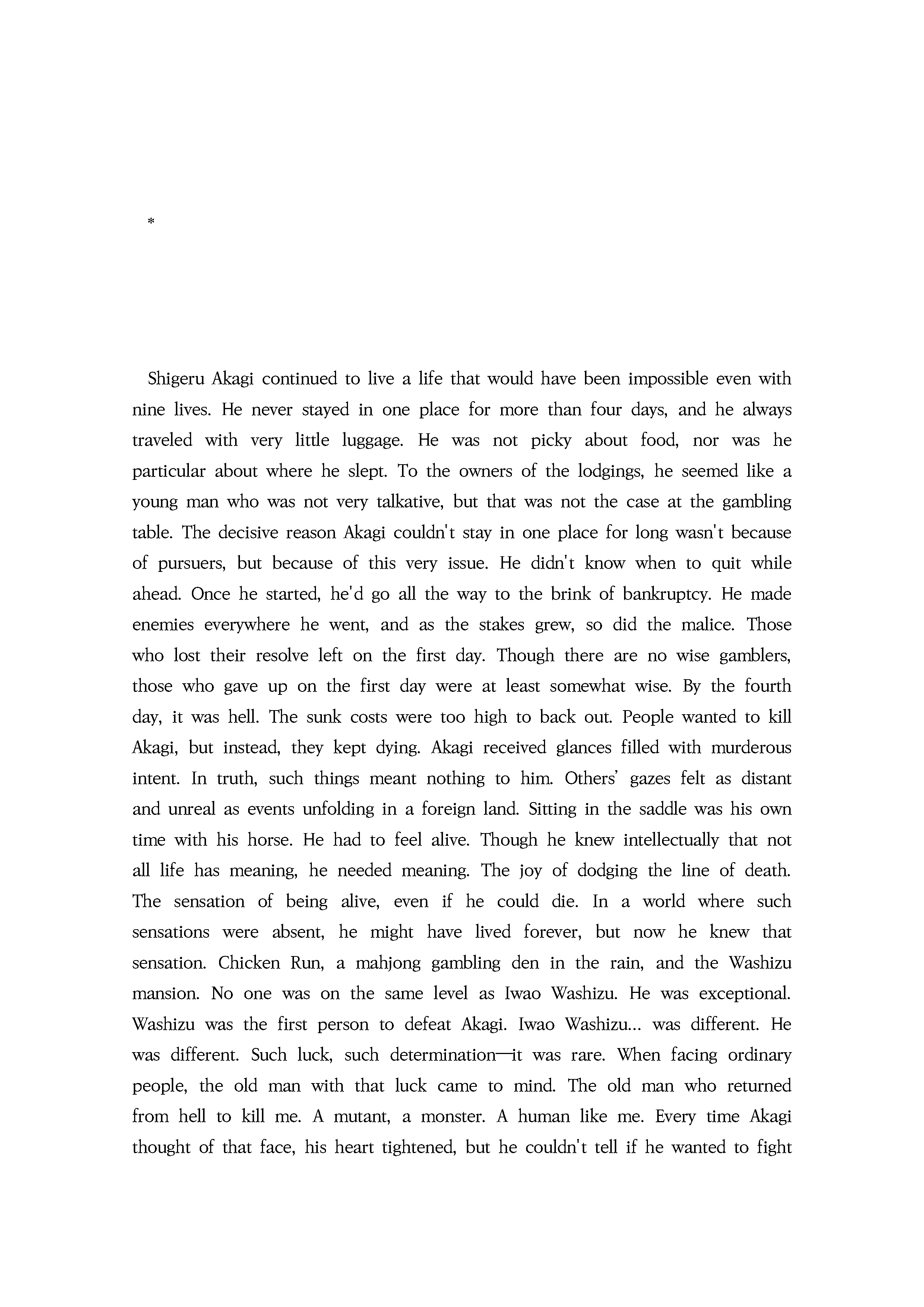
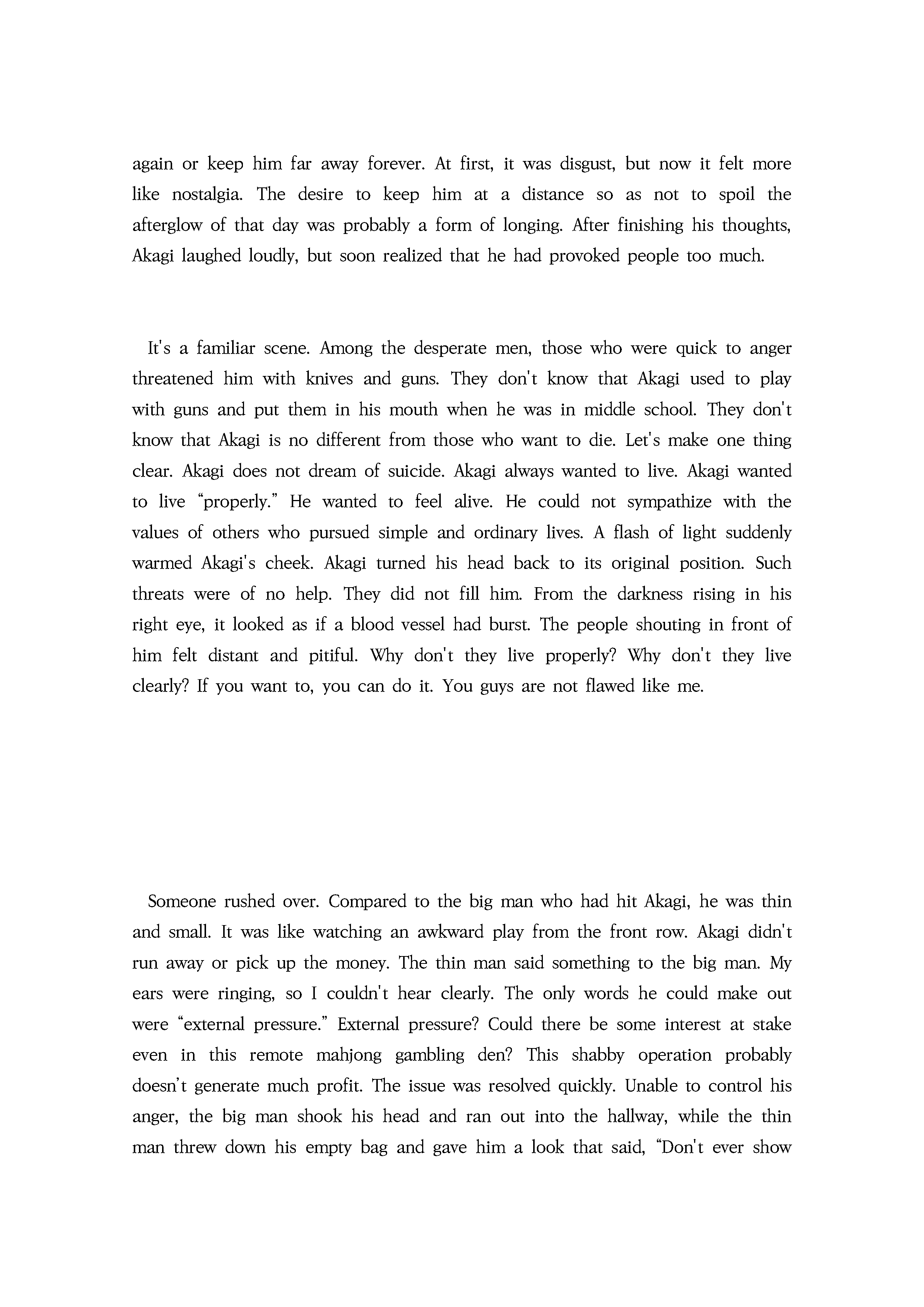
Shigeru Akagi continued to live a life that would have been impossible even with nine lives. He never stayed in one place for more than four days, and he always traveled with very little luggage. He was not picky about food, nor was he particular about where he slept. To the owners of the lodgings, he seemed like a young man who was not very talkative, but that was not the case at the gambling table. The decisive reason Akagi couldn't stay in one place for long wasn't because of pursuers, but because of this very issue. He didn't know when to quit while ahead. Once he started, he'd go all the way to the brink of bankruptcy. He made enemies everywhere he went, and as the stakes grew, so did the malice. Those who lost their resolve left on the first day. Though there are no wise gamblers, those who gave up on the first day were at least somewhat wise. By the fourth day, it was hell. The sunk costs were too high to back out. People wanted to kill Akagi, but instead, they kept dying. Akagi received glances filled with murderous intent. In truth, such things meant nothing to him. Others’ gazes felt as distant and unreal as events unfolding in a foreign land. Sitting in the saddle was his own time with his horse. He had to feel alive. Though he knew intellectually that not all life has meaning, he needed meaning. The joy of dodging the line of death. The sensation of being alive, even if he could die. In a world where such sensations were absent, he might have lived forever, but now he knew that sensation. Chicken Run, a mahjong gambling den in the rain, and the Washizu mansion. No one was on the same level as Iwao Washizu. He was exceptional. Washizu was the first person to defeat Akagi. Iwao Washizu... was different. He was different. Such luck, such determination—it was rare. When facing ordinary people, the old man with that luck came to mind. The old man who returned from hell to kill me. A mutant, a monster. A human like me. Every time Akagi thought of that face, his heart tightened, but he couldn't tell if he wanted to fight again or keep him far away forever. At first, it was disgust, but now it felt more like nostalgia. The desire to keep him at a distance so as not to spoil the afterglow of that day was probably a form of longing. After finishing his thoughts, Akagi laughed loudly, but soon realized that he had provoked people too much.
It's a familiar scene. Among the desperate men, those who were quick to anger threatened him with knives and guns. They don't know that Akagi used to play with guns and put them in his mouth when he was in middle school. They don't know that Akagi is no different from those who want to die. Let's make one thing clear. Akagi does not dream of suicide. Akagi always wanted to live. Akagi wanted to live “properly.” He wanted to feel alive. He could not sympathize with the values of others who pursued simple and ordinary lives. A flash of light suddenly warmed Akagi's cheek. Akagi turned his head back to its original position. Such threats were of no help. They did not fill him. From the darkness rising in his right eye, it looked as if a blood vessel had burst. The people shouting in front of him felt distant and pitiful. Why don't they live properly? Why don't they live clearly? If you want to, you can do it. You guys are not flawed like me.
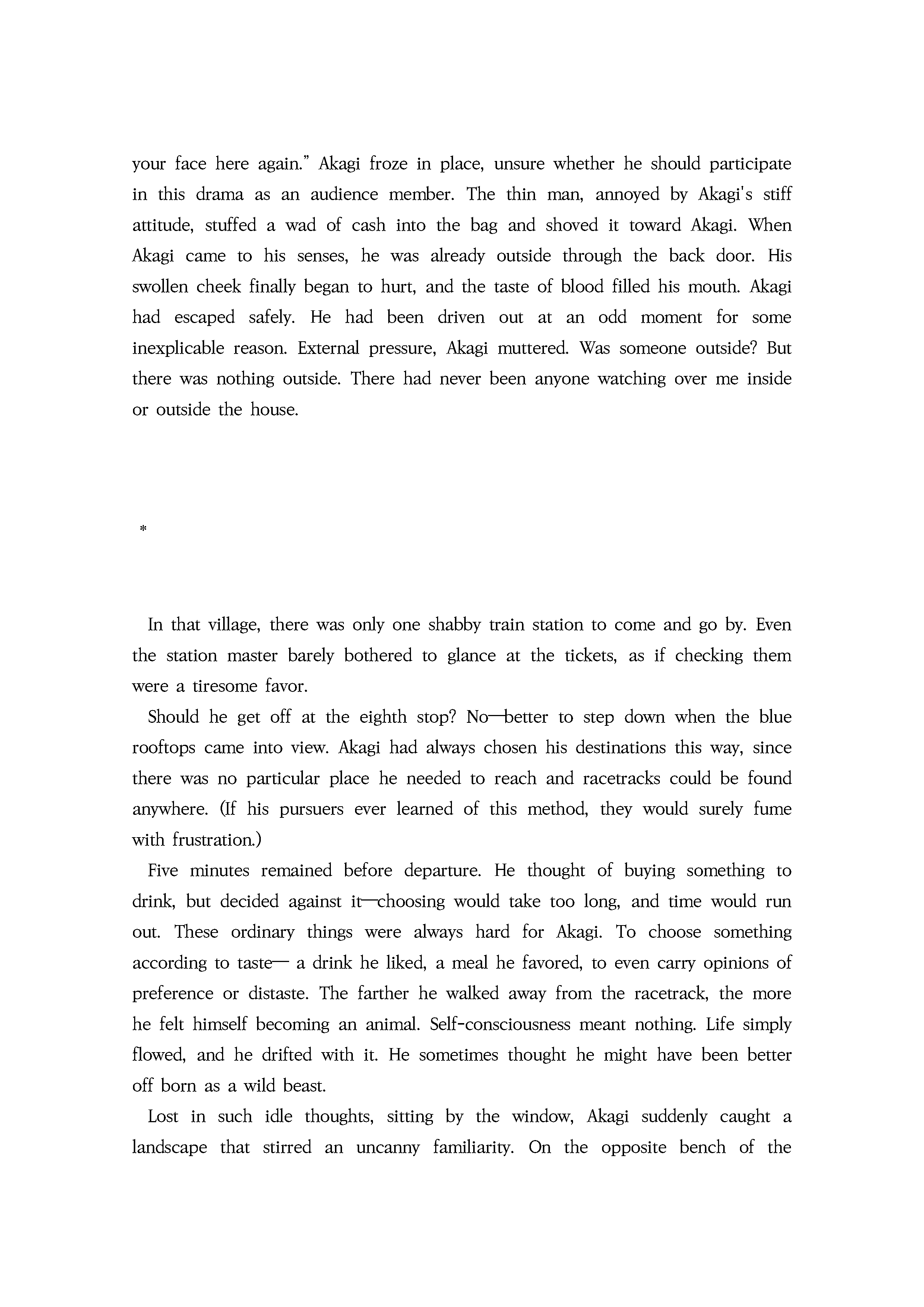
Someone rushed over. Compared to the big man who had hit Akagi, he was thin and small. It was like watching an awkward play from the front row. Akagi didn't run away or pick up the money. The thin man said something to the big man. My ears were ringing, so I couldn't hear clearly. The only words he could make out were “external pressure.” External pressure? Could there be some interest at stake even in this remote mahjong gambling den? This shabby operation probably doesn’t generate much profit. The issue was resolved quickly. Unable to control his anger, the big man shook his head and ran out into the hallway, while the thin man threw down his empty bag and gave him a look that said, “Don't ever show your face here again.” Akagi froze in place, unsure whether he should participate in this drama as an audience member. The thin man, annoyed by Akagi's stiff attitude, stuffed a wad of cash into the bag and shoved it toward Akagi. When Akagi came to his senses, he was already outside through the back door. His swollen cheek finally began to hurt, and the taste of blood filled his mouth. Akagi had escaped safely. He had been driven out at an odd moment for some inexplicable reason. External pressure, Akagi muttered. Was someone outside? But there was nothing outside. There had never been anyone watching over me inside or outside the house.
*
In that village, there was only one shabby train station to come and go by. Even the station master barely bothered to glance at the tickets, as if checking them were a tiresome favor.
Should he get off at the eighth stop? No—better to step down when the blue rooftops came into view. Akagi had always chosen his destinations this way, since there was no particular place he needed to reach and racetracks could be found anywhere. (If his pursuers ever learned of this method, they would surely fume with frustration.)
Five minutes remained before departure. He thought of buying something to drink, but decided against it—choosing would take too long, and time would run out. These ordinary things were always hard for Akagi. To choose something according to taste— a drink he liked, a meal he favored, to even carry opinions of preference or distaste. The farther he walked away from the racetrack, the more he felt himself becoming an animal. Self-consciousness meant nothing. Life simply flowed, and he drifted with it. He sometimes thought he might have been better off born as a wild beast.
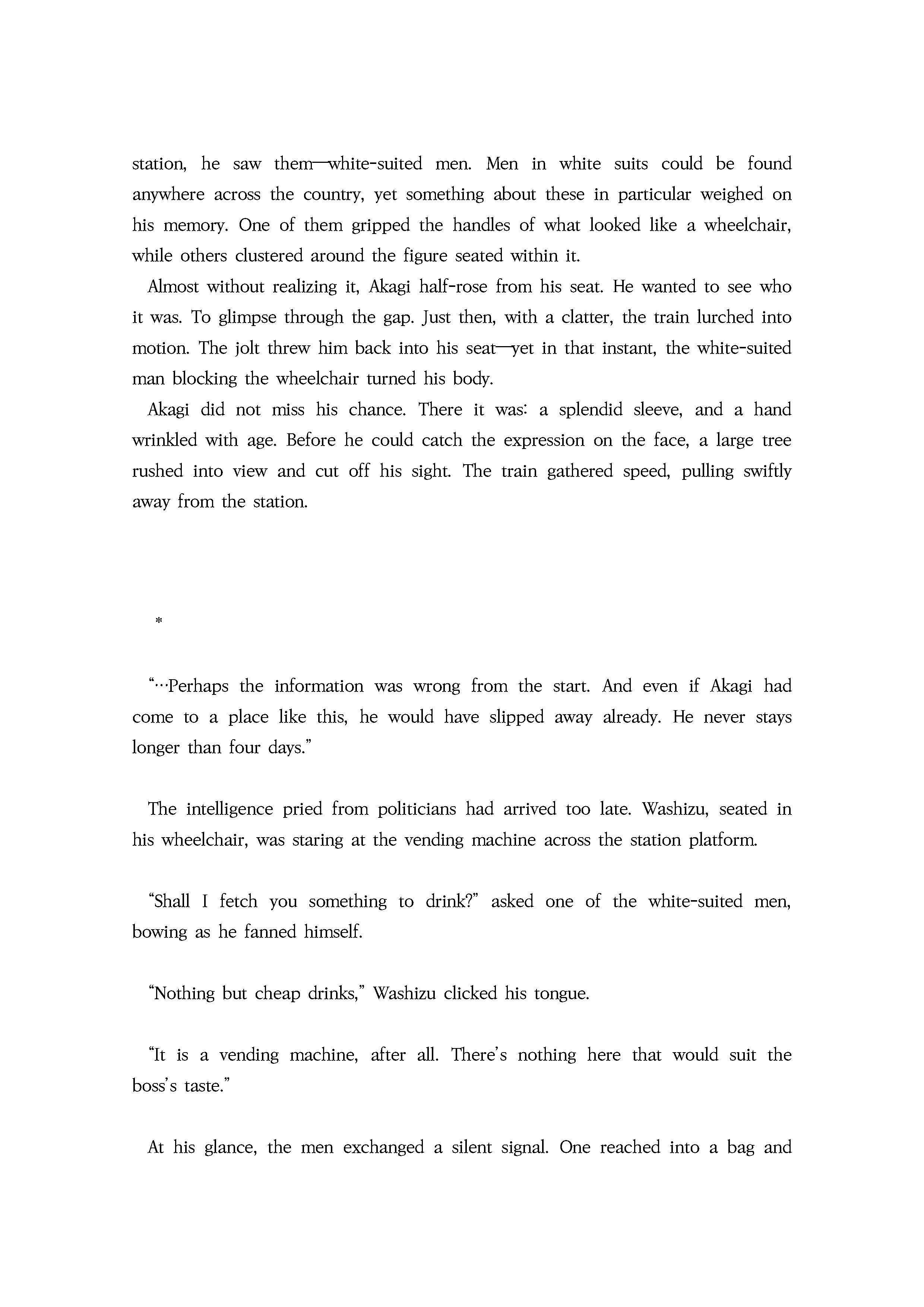
Lost in such idle thoughts, sitting by the window, Akagi suddenly caught a landscape that stirred an uncanny familiarity. On the opposite bench of the station, he saw them—white-suited men. Men in white suits could be found anywhere across the country, yet something about these in particular weighed on his memory. One of them gripped the handles of what looked like a wheelchair, while others clustered around the figure seated within it.
Almost without realizing it, Akagi half-rose from his seat. He wanted to see who it was. To glimpse through the gap. Just then, with a clatter, the train lurched into motion. The jolt threw him back into his seat—yet in that instant, the white-suited man blocking the wheelchair turned his body.
Akagi did not miss his chance. There it was: a splendid sleeve, and a hand wrinkled with age. Before he could catch the expression on the face, a large tree rushed into view and cut off his sight. The train gathered speed, pulling swiftly away from the station.
*
“…Perhaps the information was wrong from the start. And even if Akagi had come to a place like this, he would have slipped away already. He never stays longer than four days.”
The intelligence pried from politicians had arrived too late. Washizu, seated in his wheelchair, was staring at the vending machine across the station platform.
“Shall I fetch you something to drink?” asked one of the white-suited men, bowing as he fanned himself.
“Nothing but cheap drinks,” Washizu clicked his tongue.
“It is a vending machine, after all. There’s nothing here that would suit the boss’s taste.”
At his glance, the men exchanged a silent signal. One reached into a bag and produced green tea they had prepared in advance. Washizu watched their diligent hands polish the cup, fill it, and offer it to him. Then he closed his eyes.
He was certain Akagi was nearby. Ridiculous that a village with only a single station should have two mahjong gambling den—but before arrival he had already sent word to both the larger and the smaller. If the white-haired youth continues his streak, let him be. But should he lose, even once—whatever happens, whatever reprisals follow, it is no longer my concern.
If Akagi had survived, it was by virtue of his own skill. He must keep that brilliance intact. He must not rust. He must never lose his edge so long as he lived. Washizu could endure never meeting Akagi again. What he could not endure was to face him only to find him diminished, pathetic.
For men such as us, that fate was worse than death.
*
I must have grown dull. My imagination had withered. I had never once assumed that anyone might protect Me. [External pressure]
Akagi sat alone in the darkened room, slowly tasting the word. No matter how long he turned it over, it refused to dissolve. How far, he wondered, did Washizu’s pressure extend? Could fortune itself be transferred?
The news of Washizu’s death had not struck him as shocking. It was neither sad nor surprising—merely the sense of something inevitable at last unfolding. The news that shocked him most today was that he no longer knew whether he would be safe going to the mahjong parlors alone like he used to. By whose authority? By whose authority? He loathed the notion of being governed by forces outside himself.
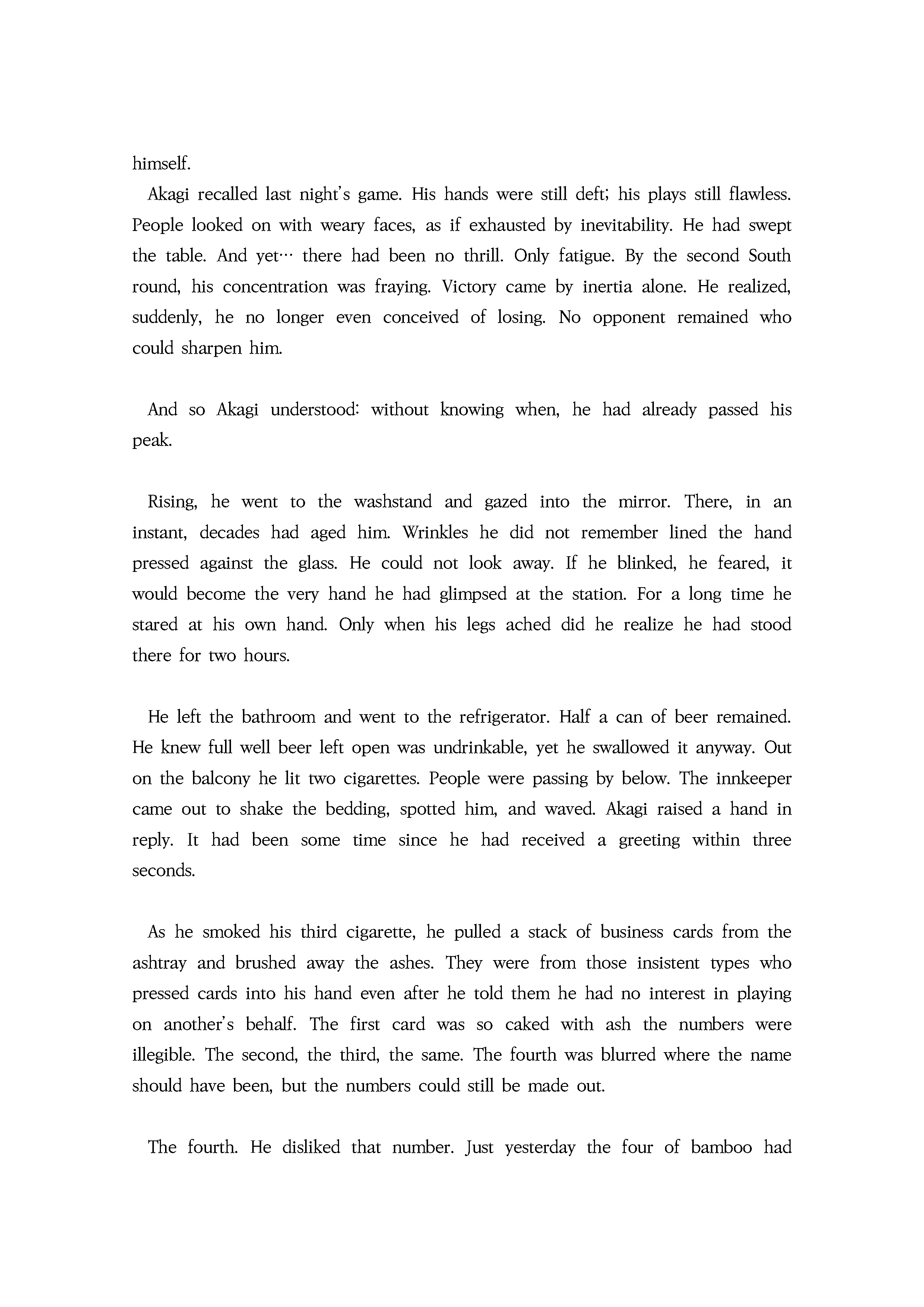
Akagi recalled last night’s game. His hands were still deft; his plays still flawless. People looked on with weary faces, as if exhausted by inevitability. He had swept the table. And yet… there had been no thrill. Only fatigue. By the second South round, his concentration was fraying. Victory came by inertia alone. He realized, suddenly, he no longer even conceived of losing. No opponent remained who could sharpen him.
And so Akagi understood: without knowing when, he had already passed his peak.
Rising, he went to the washstand and gazed into the mirror. There, in an instant, decades had aged him. Wrinkles he did not remember lined the hand pressed against the glass. He could not look away. If he blinked, he feared, it would become the very hand he had glimpsed at the station. For a long time he stared at his own hand. Only when his legs ached did he realize he had stood there for two hours.
He left the bathroom and went to the refrigerator. Half a can of beer remained. He knew full well beer left open was undrinkable, yet he swallowed it anyway. Out on the balcony he lit two cigarettes. People were passing by below. The innkeeper came out to shake the bedding, spotted him, and waved. Akagi raised a hand in reply. It had been some time since he had received a greeting within three seconds.
As he smoked his third cigarette, he pulled a stack of business cards from the ashtray and brushed away the ashes. They were from those insistent types who pressed cards into his hand even after he told them he had no interest in playing on another’s behalf. The first card was so caked with ash the numbers were illegible. The second, the third, the same. The fourth was blurred where the name should have been, but the numbers could still be made out.
The fourth. He disliked that number. Just yesterday the four of bamboo had refused to come, forcing him to draw twice around the table. Tapping the corner of the card against the balcony rail, Akagi at last made the call.
“I don’t know which syndicate you’re with…” he began, with that strange preface.
At first, he thought they meant to slight him, leaving him standing at the entrance of the estate. Instead, he was led down a corridor. Fifteen minutes wasted there, then on to an ordinary reception room. Another thirty minutes before, at last, he was shown into the chamber for honored guests.
They are measuring my worth, Akagi thought. His sudden summons had clearly thrown them into disarray. The man who arrived in haste—hastily dressed, and likely the highest-ranking available—was the captain himself.
As the captain explained his organization’s reach and the returns from substitute mahjong, Akagi murmured, “At thirteen, I never signed contracts like this.” He had not meant it as a joke, yet the room answered with polite laughter.
Akagi, in truth, understood nothing. Each time confirmation was required, he only nodded. When at last the pen was placed in his hand, he made his first demand:
“What’s the best liquor you have ready now?”
In an instant, a lavish spread appeared before him. He had not asked for food, yet sashimi arrived alongside the drink. He looked at the delicate slices and thought how strange it was that only yesterday he had drunk flat beer in a mold-scented inn room. The liquor was fine—he could tell—but it did not yet suit his tongue. That, he thought, was only a matter of time.
He sipped and signed—the contract with the yakuza as a substitute mahjong player, a contract his younger self would never have touched. A contract that now promised to shield his life.
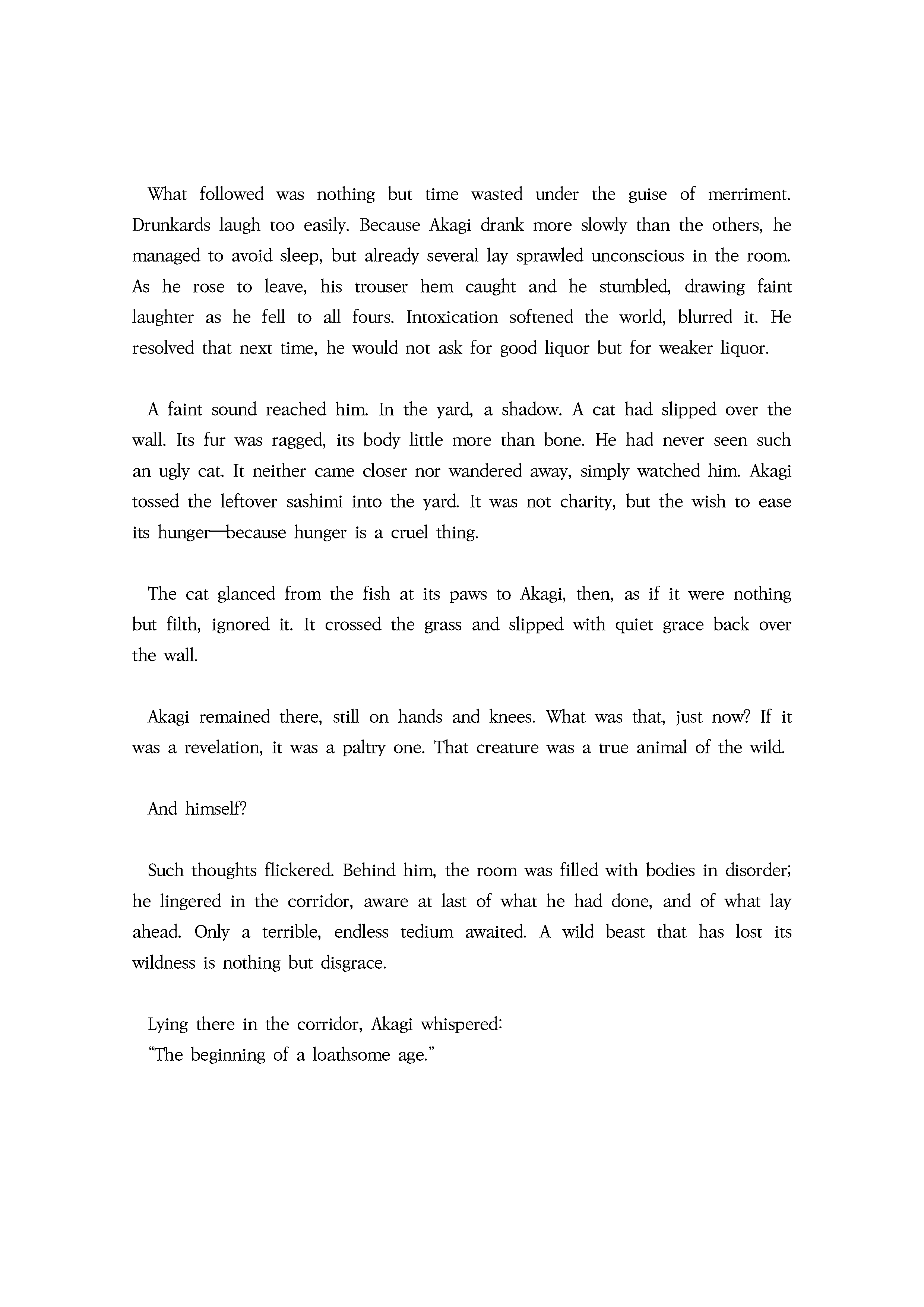
What followed was nothing but time wasted under the guise of merriment. Drunkards laugh too easily. Because Akagi drank more slowly than the others, he managed to avoid sleep, but already several lay sprawled unconscious in the room. As he rose to leave, his trouser hem caught and he stumbled, drawing faint laughter as he fell to all fours. Intoxication softened the world, blurred it. He resolved that next time, he would not ask for good liquor but for weaker liquor.
A faint sound reached him. In the yard, a shadow. A cat had slipped over the wall. Its fur was ragged, its body little more than bone. He had never seen such an ugly cat. It neither came closer nor wandered away, simply watched him. Akagi tossed the leftover sashimi into the yard. It was not charity, but the wish to ease its hunger—because hunger is a cruel thing.
The cat glanced from the fish at its paws to Akagi, then, as if it were nothing but filth, ignored it. It crossed the grass and slipped with quiet grace back over the wall.
Akagi remained there, still on hands and knees. What was that, just now? If it was a revelation, it was a paltry one. That creature was a true animal of the wild.
And himself?
Such thoughts flickered. Behind him, the room was filled with bodies in disorder; he lingered in the corridor, aware at last of what he had done, and of what lay ahead. Only a terrible, endless tedium awaited. A wild beast that has lost its wildness is nothing but disgrace.
Lying there in the corridor, Akagi whispered:
“The beginning of a loathsome age.”
[SAME. JPG VER.]






'BOOK' 카테고리의 다른 글
| 문턱에서·야생동물 (0) | 2025.08.31 |
|---|---|
| 문턱에서·야생동물 SAMPLE (0) | 2025.08.25 |
| 괴상한 것들 SAMPLE (0) | 2025.08.25 |
| 투명아빠와 나 SAMPLE (0) | 2025.08.25 |
| 모리오초 표류기 SAMPLE (0) | 2025.08.25 |